
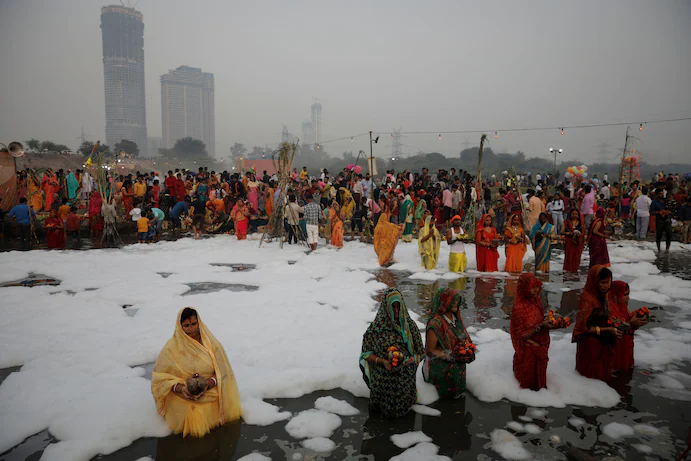
One of India’s most sacred rivers, the 855 miles of Yamuna, near the city of Delhi, is used during Hindu festival, Chhath Puja, when people dip their whole body in the water. But because of the build up in nearby untreated industrial waste and sewages, the river frequently gets covered in a blanket of white, toxic foam. To be able to make offerings to the setting sun in honor of the Sun God of Hinduism, Surya, the people of Delhi do the routine ritual of dipping their body into the waters of the river. This action exposes them to the toxic foam. Despite knowing the health risks, many devotees to the Sun God still enter the river to complete the ritual. A devotee, Rajesh Kumar Verma, states: “What fear? If we are scared, then how can we pray?”
To combat this problem, the Delhi government tried to do several things. They put up bamboo nets to act as a barrier, sent people out to “beat the foam with sticks” (presumably to try and wade it away from the bathers), and had the water sprayed with a hose to try and get rid of the foam particles. However, these methods proved unsuccessful, and many devotees were still exposed to the toxic foam.
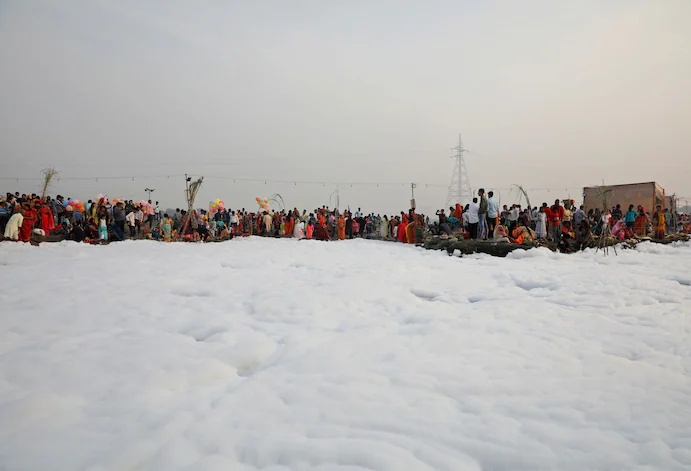
According to the World Health Organization, Delhi is ranked among the most polluted cities in the world, with “hazardous” pollution levels 39 times what the world organization sets, in air quality. The problem has gotten so bad that in India, bodies of water burn due to heavy pollution. Sadly, the government does not have enough funding to secure the necessary materials to clean up the pollution. They hope to get funding from wealthy nations throughout the world.
In conclusion, because of the spread of pollution, the result is the toxic foam that causes suffering for those less fortunate living in these highly polluted areas. India is the world’s third largest emitter of greenhouse gases. But with enough funds, they are hoping to reach net-zero emissions by 2070.